 Trending
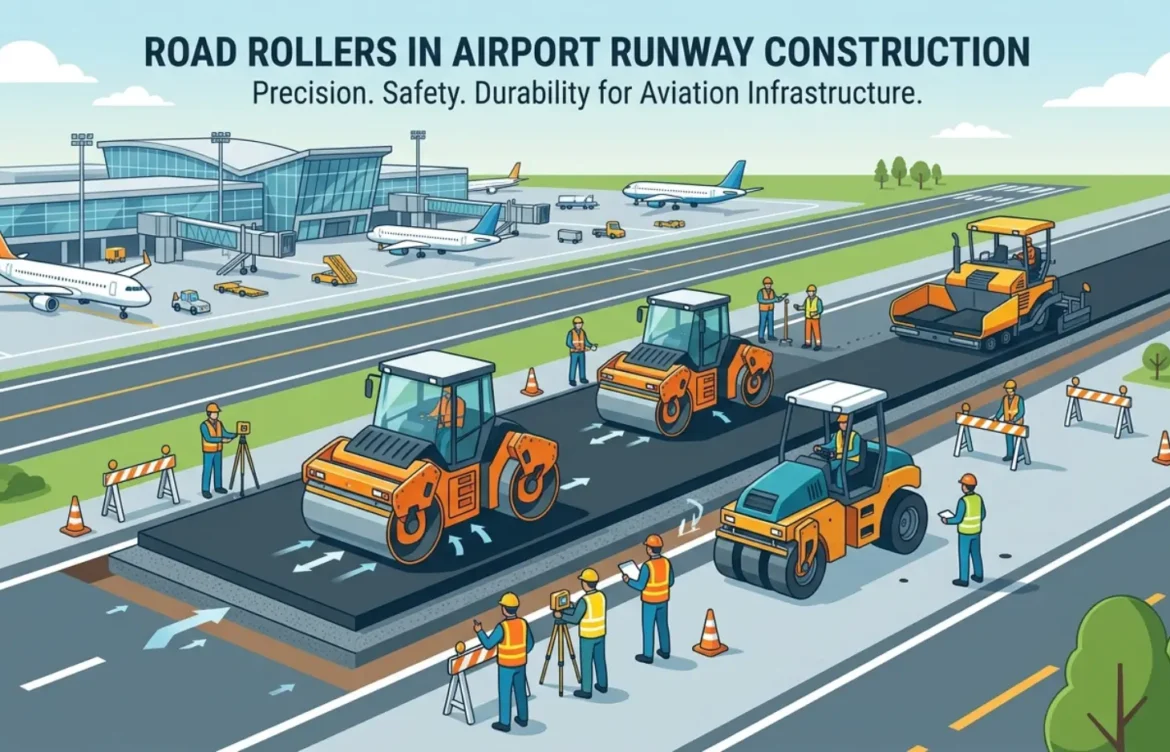
Why Road Rollers in Airport Runway Construction Are Critical
Using Road Rollers in Airport Runway Construction
The construction of an airport runway represents one of the most technically demanding projects in civil engineering. Unlike standard highways, runways must reliably support the most extreme pressures, absorb shock, and provide an uncompromisingly smooth landing and takeoff surface for a diverse range of aircraft. This process involves countless variables, from sub-base preparation to the exact timing of material placement. However, at the heart of every successful runway build lies the strategic use of road rollers.
A fully loaded commercial airliner can weigh well over 800,000 pounds. When that massive aircraft touches down at 160 miles per hour, the runway beneath it must hold strong. Standard highway paving techniques simply cannot meet the extreme, unforgiving demands of modern aviation infrastructure. Building a safe, highly reliable airport runway requires absolute precision and heavy-duty compaction equipment.
Road rollers serve as the most critical machinery in achieving the exact density and smoothness these massive projects demand. Their job extends beyond simply compressing material—they are integral to controlling material behavior, ensuring structural stability, and achieving the strict surface tolerances required by aviation authorities. Without proper compaction, even the most expensive asphalt mixtures will fail rapidly under the crushing weight of commercial jets. We know that delivering a flawless runway builds your reputation as a trusted contractor and guarantees the safety of millions of travelers.
In this comprehensive guide, we explore the vital role of road rollers in airport runway construction. You will learn how proper compaction guarantees structural durability and enhances essential passenger safety. We will also examine the specific types of heavy equipment required to achieve flawless results on the tarmac and discuss methods for optimizing every compaction pass.
A fully loaded commercial airliner can weigh well over 800,000 pounds. When that massive aircraft touches down at 160 miles per hour, the runway beneath it must hold strong. Standard highway paving techniques simply cannot meet the extreme, unforgiving demands of modern aviation infrastructure. Building a safe, highly reliable airport runway requires absolute precision and heavy-duty compaction equipment.
Road rollers serve as the most critical machinery in achieving the exact density and smoothness these massive projects demand. Without proper compaction, even the most expensive asphalt mixtures will fail rapidly under the crushing weight of commercial jets. We know that delivering a flawless runway builds your reputation as a trusted contractor and guarantees the safety of millions of travelers.
In this comprehensive guide, we explore the vital role of road rollers in airport runway construction. You will learn how proper compaction guarantees structural durability and enhances essential passenger safety. We will also examine the specific types of heavy equipment required to achieve flawless results on the tarmac.
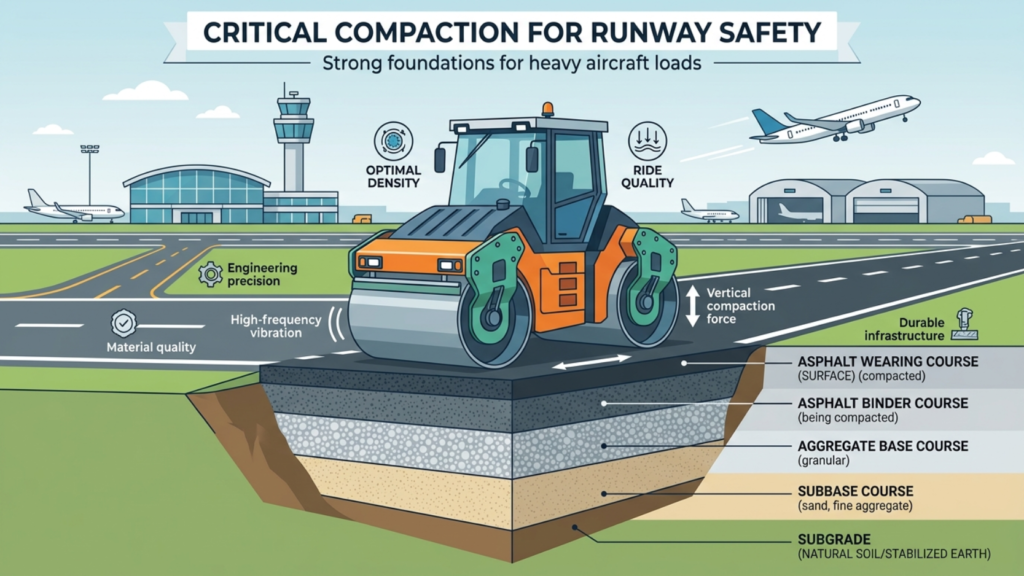
The High Stakes of Airport Runway Paving
Airport runway paving is an operation where the margin for error is virtually nonexistent. Commercial air travel depends on the structural integrity and uniformity of every square foot of runway—any flaw in compaction, density, or smoothness presents not just operational inefficiencies, but also major safety risks for crews and passengers. Unlike highway or municipal road projects, runways must withstand repetitive heavy impacts from aircraft landings and support the concentrated loads of enormous planes sitting stationary during boarding, refueling, and cargo operations.
These strict performance criteria mean that both the sub-base and the pavement surface must be constructed to exact specifications, with every layer compacted and leveled to ensure consistent structural support and load transfer. The cost of failure is measured in expensive emergency repairs, grounded flights, and—most critically—the potential for catastrophic accidents.
Success in this environment depends on experienced crews, careful planning, and the right heavy machinery. Road rollers play an indispensable role throughout every stage of construction, from initial sub-base compaction to the final surface finishing pass. Their ability to apply massive, precisely controlled force distinguishes a runway that withstands years of extreme use from one that quickly succumbs to ruts, cracks, or deformation.
A superior runway pavement must also retain optimal friction in all conditions, including rain or rapid temperature shifts. Not only does this allow for effective braking, but it also helps pilots maintain precise alignment during high-speed landings and takeoffs. To achieve all these benchmarks, every pass of the roller—every vibration, every overlap, and every rolling pattern—must be executed with meticulous discipline and informed by up-to-date engineering data.
Contractors and airport authorities that commit to proven compaction best practices, continuous equipment calibration, and operator training will consistently deliver projects that set the industry standard for safety, quality, and durability.
Aviation construction projects leave absolutely zero room for error. The pavement must endure punishing physical stress every single day, in all weather conditions. Understanding the extreme forces at play helps contractors appreciate the necessity of rigorous, uncompromising compaction methods.
Withstanding Extreme Aircraft Loads
The structural demands placed on airport runways far exceed those of standard roads or highways. When a commercial aircraft makes contact with the runway, each landing gear delivers not only tremendous static weight but also dynamic force generated by the descending plane. The kinetic energy during touchdown, combined with the subsequent deceleration, transfers intense stress straight through the asphalt and into its supporting layers. For context, the tire pressure exerted by a jet can surpass that of a loaded freight truck several times over, with each wheel often supporting upwards of 30,000 pounds.
If the foundation and surface layers lack rigorous compaction, this concentrated energy will propagate through any weaknesses, resulting in surface fracturing, rutting, or even catastrophic sub-base failure over time. Subpar compaction can also create voids beneath the pavement, leading to differential settlement—a serious threat to performance, service life, and, most importantly, safety.
Road rollers are engineered to deliver the precise overlapping passes and vibration needed to consolidate materials at these high stress points. The depth and uniformity of compaction make the difference between a runway that safely supports thousands of landings per year and one that rapidly deteriorates, risking operational delays or worse. Modern rolling equipment can be calibrated to achieve exacting levels of density across variable material thicknesses, allowing contractors to build confidence into every square foot of pavement. This tireless pursuit of compaction excellence is fundamental for airports seeking durable infrastructure and peace of mind during every arrival and departure.
The impact of a landing aircraft transfers immense kinetic energy directly into the pavement. Commercial aircraft tires carry inflation pressures exceeding 200 pounds per square inch. If the asphalt or sub-base lacks proper density, this repeated, concentrated trauma will instantly fracture the surface.
Our industry understands that premature pavement failure is not just a minor inconvenience; it represents a catastrophic safety hazard. Road rollers provide the deep, structural compaction required to lock paving materials tightly together. This intense compression builds an impenetrable foundation capable of supporting massive international flights year after year without severe rutting.
Ensuring Uncompromising Passenger Safety
The safety of every passenger and crew member relies directly on the structural integrity and reliability of the runway surface. Unexpected variations in surface quality, such as shallow depressions, micro-cracks, or even minute ruts, can introduce significant operational risks—especially during high-speed landings, adverse weather, or emergency maneuvers. For instance, subtle undulations can impact an aircraft’s braking distance and directional control, making it more difficult to stay precisely on the centerline during rollout or takeoff. The margin for error is nearly nonexistent.
To mitigate these risks, every compaction pass must be executed with rigorous attention to detail. Road rollers eliminate surface and sub-surface inconsistencies before the asphalt cools and becomes unyielding. Modern roller technology, often equipped with sensors and real-time monitoring systems, allows operators to precisely measure surface flatness and density as they work. This ensures that even hidden imperfections are addressed, resulting in a strikingly flat and even runway surface.
Moreover, proper roller operation contributes to achieving the optimal surface texture required for maximum tire grip—critical for safe deceleration, directional stability, and rapid stops in the event of aborted takeoffs. By locking aggregate particles together and eliminating air pockets below the surface, rollers help prevent the formation of surface water films, which can otherwise lead to dangerous hydroplaning.
Airport authorities and contractors who prioritize exacting compaction standards consistently deliver runways that not only comply with regulatory specifications but genuinely protect lives. In practice, this dedicated approach to surface integrity provides pilots with complete confidence during their most critical operations, ensuring that takeoffs and landings are as safe and predictable as possible for everyone on board.
Safety remains the absolute highest priority in the aviation industry. A runway must provide maximum friction for heavy braking while remaining perfectly level to prevent aircraft from pulling off the centerline. Even minor depressions, uneven seams, or slight ruts in the pavement can cause disastrous accidents during high-speed takeoffs.
Road rollers eliminate these hidden imperfections before the hot asphalt cools and sets permanently. By pressing the paving materials into a uniformly dense layer, rollers create a highly reliable, predictable surface. We know that delivering this exceptional level of precision gives pilots the total confidence they need to operate safely.
The Science of Runway Pavement Compaction
Compaction science sits at the core of every successful airport runway project. Unlike typical paving jobs, where variability might be tolerated for sidewalks or low-traffic roads, runways require a standard of uniformity and density that leaves no room for error. The physical process involves not just compressing asphalt layers, but fundamentally transforming the molecular arrangement of materials to achieve maximum strength, minimal permeability, and a perfectly even surface capable of enduring decades of relentless use.
Engineers and contractors must account for material type, layer thickness, ambient temperature, and specific aviation authority requirements while planning each step. Advanced laboratory testing prior to construction helps identify the ideal mix and compaction strategy, ensuring that every project begins with a solid blueprint for success.
The actual compaction process involves a sequence of rolling passes—each with its own purpose. While initial passes target bulk density and remove major air voids, subsequent passes focus on surface texture, seamless joint integration, and final smoothness. State-of-the-art rollers are often equipped with sensors that measure real-time density and temperature, enabling teams to make immediate adjustments in the field and achieve the toughest international standards.
By approaching runway compaction with this level of scientific rigor and attention to detail, contractors can assure project stakeholders—especially airport authorities and civil engineers—that every effort has been made to maximize the functional lifespan, safety, and performance of the finished runway.
Achieving the perfect runway requires manipulating the physical properties of hot mix asphalt. When the paving machine lays down the material, it contains millions of tiny air pockets. Contractors must use heavy machinery to fundamentally change the structure of this material.
Eliminating Dangerous Air Voids
Effective compaction is critical to removing air voids within each layer of the runway pavement structure. Air voids may seem harmless on the surface, but even small amounts become serious liabilities under aviation loads. When compacting hot mix asphalt, the primary goal is to achieve a dense, impermeable structure that will resist not just dynamic pressure but also the persistent threat of water ingress.
Water is the single most destructive element to airfield pavement longevity. If allowed to penetrate through the pavement and into the base or sub-base, water undermines the supportive layers, eventually causing pavement distress such as potholes, alligator cracking, or base failure. In cold climates, infiltrated moisture freezes, expands, and exerts upward pressure (frost heave), which can create sudden, hazardous surface deformations that threaten runway operations.
Airport construction standards are even stricter than those for highways; maximum allowable air void percentages are specifically dictated by aviation authorities, often in the 3–4% range, to ensure both safety and extended service life. Achieving and consistently maintaining these low air void ratios is only possible with the use of properly calibrated, high-performance road rollers making methodical passes as dictated by compaction data and temperature readings.
Special consideration must also be given to seams, longitudinal joints, and repairs, which are especially prone to air void accumulation if not compacted and sealed correctly. Operators must be trained to pay close attention to these vulnerable areas on every pass. Compaction records should be documented in real time, using intelligent compaction technology where possible, to confirm that each section of the runway meets the required specifications before work proceeds.
By systematically eliminating air voids, contractors deliver runway surfaces that are highly resilient and low-maintenance, withstanding decades of heavy jet landings, rapid acceleration, and frequent environmental exposure. The upfront investment in proper compaction translates directly to minimized repair costs, fewer operational disruptions, and safer travel for all runway users.
Leaving excessive air voids inside the runway structure invites rapid, costly deterioration. Water quickly seeps into these empty spaces, freezing and expanding during winter months to physically tear the pavement apart. Aviation specifications typically require contractors to compact the asphalt until only three to four percent of air voids remain.
Heavy-duty road rollers apply immense mechanical pressure to squeeze these voids out of the mixture completely. This process forces the crushed aggregate stones to interlock permanently, sealing the surface against moisture infiltration. Achieving this precise density target ensures the runway resists environmental damage and chemical spills from aviation fuel.
Achieving Precise Surface Smoothness
Surface smoothness is more than a cosmetic concern—it’s a cornerstone of runway performance and aircraft safety. Federal aviation guidelines enforce incredibly strict tolerances for runway smoothness, recognizing that even minor irregularities can translate into intense vibrations, erratic handling, and mechanical stress on both aircraft and passengers. A rough surface accelerates wear on expensive landing gear components and can create violent, unsettling vibrations inside the passenger cabin, especially during takeoff and landing rolls.
To meet these stringent standards, construction crews must utilize advanced application techniques and precise machinery calibration. Operators rely on specialized road rollers to methodically iron out surface imperfections, paying careful attention to both longitudinal and transverse joints where separate paving passes intersect. A special focus is placed on the integration of joints, as misaligned or uneven seams can quickly develop into points of weakness under repetitive jet traffic.
Modern rolling operations often use a multi-stage approach to perfect the surface profile. Initial passes with vibratory steel rollers address bulk compaction, while subsequent finishing passes—sometimes performed with static steel-wheeled rollers—refine the surface appearance and mechanical properties. Laser-guided screeds and real-time smoothness measurement tools enable crews to take corrective action instantly, ensuring each pavement section falls within the allowable deviation of just a few millimeters over several meters of runway length.
Beyond regulatory compliance, a uniformly smooth surface reduces rolling resistance for aircraft tires, resulting in improved takeoff performance, more efficient braking, and less fuel consumption during acceleration. By eliminating tiny ridges, undulations, and mismatched seams, contractors not only extend the lifespan of the pavement but also contribute to a safer and more cost-effective operational environment.
The final result is a continuous, perfectly flat ribbon of pavement that not only meets but often exceeds strict regulatory standards—guaranteeing a safe, efficient, and comfortable experience for flight crews and passengers alike.
Federal aviation guidelines enforce incredibly strict tolerances for runway smoothness. A rough surface accelerates wear on expensive aircraft landing gear and creates violent, unsettling vibrations inside the passenger cabin. Construction crews must meet exacting specifications that penalize any deviation in surface flatness.
Operators use specialized road rollers to iron out the longitudinal and transverse joints where different paving passes meet. This careful, calculated rolling technique blends the seams together seamlessly. The final result is a continuous, perfectly flat ribbon of pavement that meets strict regulatory standards and guarantees a smooth ride.
Essential Road Rollers for Runway Projects
Selecting and operating the right mix of road rollers is crucial for the success of every airport runway construction project. This not only involves matching specific roller types to each phase of compaction but also ensuring these machines are calibrated and maintained to perform at peak efficiency under demanding conditions. Runway paving places extraordinary demands on equipment and operators alike, and only a well-coordinated fleet can meet the stringent requirements set by aviation authorities.
Heavy-Duty Vibratory Steel Rollers
Vibratory steel-wheeled rollers remain the industry standard for achieving primary compaction on thick asphalt runway lifts. Their steel drums, fitted with powerful vibratory mechanisms, deliver intense energy deep into the material, rapidly increasing the pavement’s density. Thanks to controllable vibration settings, operators can tailor compaction intensity according to material type and lift thickness, preventing both under- and over-compaction.
For airport projects, it is common to deploy tandem vibratory rollers—machines with front and rear drums—to maximize the compactive effort and minimize material displacement. These rollers are equipped with modern onboard sensors and temperature gauges to help operators identify the optimal compaction window. In practice, effective use of vibratory rollers accelerates progress while ensuring strict adherence to project density specifications.
It is also essential that vibratory rollers adapt swiftly to changing temperatures, as the cooling asphalt becomes increasingly difficult to compact properly. This makes operator skill and the use of advanced auto-feedback systems vital for delivering consistent sub-base and base-layer performance on large, open runway stretches.
Pneumatic Tire Rollers for Surface Sealing
Once initial compaction is complete, pneumatic tire rollers move into position for intermediate compaction—an equally important step that defines the runway’s long-term performance. Instead of rigid drums, these rollers have multiple overlapping rubber tires, each capable of adjusting to subtle surface irregularities. This design delivers a gentle kneading action that effectively closes minor voids and integrates surface aggregates, drawing bitumen to create a durable sealed crust.
In airport construction, pneumatic rollers are especially valuable for working over joints, transitions between material lifts, and in areas vulnerable to air and water infiltration. Their ability to manipulate the surface mix leads to dense yet flexible pavement, which absorbs the constant stress of heavy aircraft without cracking or delaminating.
Modern pneumatic tire rollers often feature dynamic ballasting systems, enabling crews to increase machine weight as needed based on updated compaction test data. This flexibility is instrumental when adapting to unique airfield challenges, such as variable mix temperatures and unpredictable weather.
Static Steel-Wheeled Rollers for the Final Finish
No runway is complete without a professional finishing pass. Static steel-wheeled rollers provide this final touch, relying on their substantial mass rather than vibration to compress the upper layer of cooling asphalt. The goal in this stage is not to affect foundational density but to impart a flawless, glass-like smoothness that meets the tightest global flatness tolerances.
A well-executed finish rolling operation eliminates surface blemishes left by earlier machinery, including tire impressions, ridges, and micro-tears. Skilled operators often use overlapping paths, careful speed control, and attention to surface temperature to perfect the final lift. For airport authorities, the smoothness data collected after finish rolling becomes a critical element of formal runway certification.
Intelligent Compaction Technology
Intelligent Compaction (IC) systems represent the cutting edge of modern mass paving operations. These systems incorporate GPS positioning, infrared temperature measurement, and real-time density mapping, allowing operators and project managers to monitor compaction quality as work progresses—eliminating guesswork and human error.
IC technology enables projects to track exactly how many roller passes have occurred over every section, ensure consistent compaction even on wide or complex runway geometries, and instantly identify areas requiring additional attention. This level of real-time data collection supports a proactive approach to compaction quality: adjustments can be made mid-project, preventing subpar sections from developing into problematic weak spots.
By deploying IC-equipped rollers, construction teams not only streamline quality assurance reporting but also confidently deliver on international aviation standards, strengthening their reputation for reliability and project excellence.
No single machine can handle every phase of runway compaction. Equipment manufacturers design specific types of rollers to achieve distinct results during the paving process. Utilizing the correct sequence of machinery guarantees you meet your strict density and smoothness requirements.
Heavy-Duty Vibratory Steel Rollers
Heavy-duty vibratory steel rollers are indispensable during the initial breakdown phase of airport runway construction, setting the standard for density and consistency across the entire pavement structure. These rollers are engineered with one or two large steel drums—often over two meters wide—each fitted with powerful internal vibratory mechanisms. By rapidly rotating eccentric weights inside the drum, the machine delivers both vertical and horizontal energy, imparting intense, high-frequency vibrations deep into the asphalt mat.
This dynamic impact serves multiple essential purposes. First, it enables the aggregate particles within the asphalt mix to rearrange and interlock as tightly as physically possible, directly translating to maximum achievable density and minimized air void content. Second, the vibration helps the viscous asphalt binder to flow and coat each aggregate particle, ensuring structural cohesion and improved durability against heavy aircraft loading.
Vibratory rollers in runway projects are typically equipped with advanced operator controls and real-time data systems. These features allow for precise adjustment of vibration amplitude and frequency based on factors such as lift thickness, mix temperature, and material type. Many modern units also integrate GPS mapping and onboard computers, empowering contractors to monitor every roller pass for coverage and identify areas that may require additional compactive effort.
Strategic use of vibratory rollers should always be paired with careful timing. Operators must ensure compaction occurs when the asphalt is within the optimal temperature range—hot enough to permit granular movement and binder flow, but not so hot as to risk shoving or over-compaction. Multiple overlapping passes, typically in a staggered pattern, are recommended to eliminate both surface and deep-seated irregularities, resulting in a runway base that is uniform, stable, and ready for advanced finishing. This level of attention to detail underscores a commitment to reliability and operational excellence, driving long-term performance for high-traffic airport environments.
Achieving deep structural density requires aggressive, relentless mechanical force. Vibratory steel-wheeled rollers serve as the primary workhorses during the initial breakdown phase of runway construction. These massive machines feature internal eccentric weights that rotate rapidly inside their heavy steel drums.
As the roller moves, it sends high-frequency shockwaves deep into the thick asphalt lifts. This intense vibration shakes the aggregate particles into their tightest possible configuration. We rely on vibratory rollers to do the heavy lifting immediately behind the paver, while the asphalt remains at its absolute peak temperature.
Pneumatic Tire Rollers for Surface Sealing
Pneumatic tire rollers are an essential component of the runway compaction sequence, taking on the specialized task of intermediate, or “proof,” compaction after vibratory rollers have established core density. Unlike their steel-drum counterparts, pneumatic rollers are equipped with multiple overlapping rubber tires, often nine or more, which collectively provide a broad, even coverage across the runway surface. Each tire is independently inflated, allowing the machine to adapt to slight irregularities in the pavement and apply uniform pressure—crucial for airfield projects where perfection is non-negotiable.
The principal advantage of pneumatic rollers lies in their unique kneading action. As the machine traverses the fresh asphalt, the flexible tires gently compress and rearrange the surface particles. This action not only seals minor surface fissures and draws the asphalt binder upward, but also integrates the aggregates more homogeneously. The result is a dense, water-resistant crust that significantly mitigates the risk of future surface permeability issues. Contractors recognize this sealed finish as a decisive factor in preventing water ingress—a leading cause of premature runway deterioration, freeze-thaw damage, and sub-base erosion.
In addition to enhancing waterproofing, pneumatic tire rollers are invaluable for their ability to compact around the edges of longitudinal and transverse joints, which are inherently vulnerable to low-density pockets. Their maneuverability and adjustable ballast systems make them well-suited for fine-tuning compaction levels based on fluctuating site conditions and varying lift thicknesses. Many modern models offer centralized inflation control, enabling rapid adjustments to tire pressure on the fly—a valuable asset for sites contending with material variations or temperature swings.
To maximize effectiveness, operators must be trained not only in baseline machine operation but in understanding how tire pressure, roller speed, and pass overlap influence density distribution. Meticulous adherence to rolling patterns and the use of real-time compaction data are essential for consistently delivering joints and surface finishes that meet or exceed aviation authority specifications. In summary, pneumatic tire rollers bridge the gap between deep compaction and surface perfection, helping contractors achieve runway pavements renowned for their durability, performance, and unrivaled service life.
After the vibratory rollers achieve the core density, the pavement requires dedicated intermediate compaction. Pneumatic tire rollers feature staggered rows of smooth, heavily inflated rubber tires. Because the tires are flexible, they manipulate the hot asphalt much differently than rigid steel drums do.
The heavy rubber tires provide a unique kneading action that draws the liquid asphalt binder directly toward the surface. This process perfectly seals the top of the runway, closing tiny hairline cracks and minimizing surface permeability. Using pneumatic rollers guarantees a watertight finish that drastically extends the operational lifespan of the runway.
Static Steel-Wheeled Rollers for the Final Finish
Static steel-wheeled rollers represent the cornerstone of perfecting the surface during the last phase of runway compaction. These robust machines, often weighing upwards of 10 tons, utilize their immense static weight to uniformly press the uppermost asphalt layer—without relying on vibration. Their role is not to increase structural density, which has already been achieved by previous rolling stages, but rather to refine the surface appearance, texture, and smoothness to within the most demanding tolerances set by aviation authorities.
The final finish rolling is a highly delicate operation. Operators must carefully monitor both speed and surface temperature, ensuring the asphalt has reached the optimal range for imprinting without causing further deformation. Too fast, and the roller may leave surface imperfections; too slow, and the asphalt could cool excessively, becoming resistant to further refinement. Experienced crews often rely on infrared thermometers, visual cues, and precise timing to strike this balance, ensuring every inch of the runway meets the rigorous flatness and ride quality standards that pilots and aircraft manufacturers expect.
Additionally, static steel-wheeled rollers play a vital role in eliminating marks or slight irregularities left behind by pneumatic or vibratory machines. The smooth, unbroken surface created by this process not only improves the visual quality of the runway but also delivers tangible safety benefits. It reduces friction variations, prevents pooling of rainwater, and ensures consistent contact for aircraft tires—all critical factors in high-speed aircraft takeoffs and landings.
To maximize the effectiveness of finishing passes, operators typically employ overlapping rolling patterns, methodically working from edge to center or vice versa depending on the project blueprint. Routine calibration of rolling pressure and real-time monitoring of the contact surface are best practices proven to deliver repeatable, high-precision results. This unwavering attention to detail exemplifies a commitment to operational excellence, significantly reducing the likelihood of future maintenance needs and ensuring the long-term performance of the runway under daily airline operations.
The final phase of runway compaction focuses entirely on surface perfection. Static steel-wheeled rollers rely solely on their massive operating weight to press the pavement flat. They operate without any internal vibration, simply rolling smoothly and quietly over the cooling asphalt.
Skilled operators use these heavy machines to erase any lingering tire marks or slight ridges left by the previous compaction equipment. The static rolling pass delivers the pristine, mirror-smooth finish required for safe, high-speed aircraft operations. Utilizing this exact sequence of equipment ensures the final product exceeds all engineering expectations.
Intelligent Compaction Technology
Intelligent Compaction (IC) technology stands at the forefront of modern runway construction, setting new standards for process control, documentation, and finished pavement quality. These advanced systems seamlessly integrate engineering-grade GPS, high-resolution infrared temperature sensors, and precise onboard accelerometers or stiffness meters directly into the road roller’s operating framework. In real time, operators access detailed data on compaction uniformity, surface and subsurface temperatures, pass counts, and achieved material densities. Operators—and project managers overseeing from the office—can instantly identify low-density pockets, under-compacted joints, or areas that have exceeded safe temperature ranges.
With IC, each roller pass is electronically mapped and stored, making it possible to verify, report, and review compaction coverage for every square meter of pavement laid. This robust data trail becomes invaluable for contractors, airport authorities, and civil engineers seeking to demonstrate compliance with international aviation standards or to troubleshoot long after construction has concluded. Adjustment for environmental variables, like ambient temperature or unexpected material variability, can now happen on the fly, dramatically reducing the risk of rework or costly project delays.
The practical advantages extend beyond compliance. By providing actionable guidance through visual dashboards or even automated roller adjustments, IC systems allow less experienced operators to deliver expert-level results. Reductions in over-compaction not only preserve the desired material properties but also extend roller lifespan and reduce unnecessary fuel consumption. The end result is a smoother, stronger, and longer-lasting runway, with process transparency and accountability at every step.
In today’s competitive infrastructure market, adopting intelligent compaction is more than a technological upgrade—it’s a mark of operational excellence and a clear demonstration of long-term commitment to durability, safety, and value for your clients.
Modern runway construction increasingly relies on advanced data collection. Intelligent Compaction (IC) rollers feature integrated GPS mapping, infrared temperature sensors, and onboard density measurement tools. These high-tech rollers provide operators with real-time feedback on a digital display screen inside the cabin.
IC technology removes the guesswork from the compaction process. The operator can clearly see which areas of the runway have achieved target density and which areas require another pass. We strongly support the adoption of IC rollers, as they guarantee uniform compaction across the entire length of the runway and prevent damaging over-compaction.
Executing a Flawless Compaction Strategy
The path to a flawless airport runway is paved with more than just cutting-edge equipment—it is equally driven by rigorous field strategy, attention to environmental factors, and a culture of discipline among operations teams. Overcoming the complex demands of aviation paving requires not only the deployment of advanced road rollers but also a proactive approach to planning, sequencing, and on-the-fly decision-making.
Comprehensive Pre-Project Planning
Long before the first roller touches the fresh asphalt, project success is determined in the planning phase. Reliable contractors work in close partnership with airport authorities and civil engineers to analyze mix designs, sub-base compositions, traffic projections, and likely climate conditions. Implementing robust site logistics—including the staging of rollers, fuel access, and contingency routes—ensures that compaction can proceed without unnecessary interruptions or delays.
Additionally, rehearsal sessions or pre-construction meetings giving operators clarity on the project blueprint, rolling patterns, and safety protocols set the standard for operational excellence. Clear communication and chain-of-command protocols are vital, especially when working in active airfield environments or within strict construction time windows.
Mastering Temperature Control
Compacting a runway is a constant race against time and temperature. If the asphalt cools too much before the rollers arrive, it becomes hopelessly stiff and impossible to compress. If operators roll the material while it is too hot, the asphalt will shove and deform under the heavy steel drums.
Construction crews must monitor pavement temperatures constantly to ensure they hit the perfect compaction window. Modern projects utilize handheld infrared thermometers, embedded temperature sensors, and even real-time compaction software to monitor conditions across the entire worksite. Regular temperature checks at various pavement depths help operators adjust roller speeds, alter rolling sequence, or temporarily pause work if mix temperatures fall outside optimal parameters.
Managing this tight temperature range ensures the road rollers achieve the target density without destroying the structural integrity of the mix. The most successful teams include temperature management in daily pre-shift briefings, equipping every operator and supervisor with the knowledge required to take swift, informed action at the first sign of deviation. This vigilance directly safeguards pavement performance and final project quality.
Establishing Consistent Rolling Patterns
Random or overlapping rolling passes inevitably lead to uneven pavement density, jeopardizing both safety and durability. Project managers must establish strict, highly organized rolling patterns for the equipment operators to follow. Best practices dictate overlapping roller passes, working systematically from pavement edges to the center (or vice versa), ensuring uniform compaction coverage.
Every operator must know exactly how fast to drive, how much to overlap their previous pass, and when to engage the vibratory systems. Field supervisors use GPS tracking and compaction logs to document progress and confirm adherence to rolling protocols. This on-the-ground data collection supports continuous improvement, allowing teams to fine-tune techniques for greater efficiency and quality across future projects.
Many runway projects utilize echelon paving, where multiple pavers and rollers work side-by-side simultaneously. This keeps the longitudinal joints hot, allowing the rollers to compact the seams perfectly, preventing cold joints and minimizing weak spots at pavement interfaces. For exceptionally large or high-traffic airfields, coordination between rolling teams and paving crews becomes critical, with radio communication and sequencing charts used to orchestrate complex movements with precision.
When you execute a highly disciplined compaction strategy, you build a runway that not only withstands the ultimate test of heavy commercial aviation but also sets a benchmark for operational reliability, client confidence, and long-term cost savings.
Having the right machinery only solves half the puzzle. Executing a major airport paving project requires meticulous planning, precise timing, and highly disciplined operators.
Mastering Temperature Control
Effective temperature management is one of the most critical—and often underestimated—factors in achieving optimal runway compaction. Hot mix asphalt must be compacted within a specific temperature range to ensure its molecular structure is properly consolidated. If asphalt cools below the ideal threshold before rolling begins, the binder stiffens and aggregate movement is restricted, leading to high air void content and insufficient density. Conversely, if compaction is attempted while the asphalt is excessively hot, the mix can become unstable, resulting in surface shoving, rutting, or even irreversible deformation under the roller’s weight.
To mitigate these risks, project teams employ a suite of temperature monitoring tools, including hand-held infrared thermometers, embedded surface probes, and—on more advanced sites—wireless thermal mapping systems that provide continuous temperature data across the work zone. Crews are trained to take temperature readings at regular intervals and at depths corresponding to the full thickness of the lift. This granular level of monitoring allows for precise adjustments to rolling sequence, compactive effort, and roller speed as site conditions evolve throughout the day.
In addition, disciplined staging and sequencing of road rollers is paramount. Equipment must be queued and ready to operate as soon as paving is complete, minimizing time delays between mat laydown and initial compaction. Some projects designate dedicated “temperature marshals” responsible for alerting operators when temperature windows are approaching critical points, allowing for proactive decision-making and workflow adjustments.
Proper scheduling ensures that rollers are not idling or running inefficiently while waiting for paving crews; rather, they are deployed in an orchestrated fashion to optimize both time and thermal profiles. This integrated approach to temperature management is essential—not just for achieving material density, but also for delivering the surface smoothness, durability, and safety outcomes that define top-tier runway construction.
Compacting a runway is a constant race against time and temperature. If the asphalt cools too much before the rollers arrive, it becomes hopelessly stiff and impossible to compress. If operators roll the material while it is too hot, the asphalt will shove and deform under the heavy steel drums.
Construction crews must monitor pavement temperatures constantly to ensure they hit the perfect compaction window. Managing this tight temperature range ensures the road rollers achieve the target density without destroying the structural integrity of the mix.
Establishing Consistent Rolling Patterns
Establishing a consistent, strategic rolling pattern is paramount to achieving the uniform pavement density required for airport runway longevity and safety. Haphazard or poorly-planned passes can result in soft spots, low-density pockets, or over-compacted areas—each of which threatens the structural integrity and performance of the finished runway.
A best-in-class rolling pattern always begins with a clear compaction plan drafted before work commences. Project managers and site supervisors collaborate to define the direction, speed, and overlap of each pass, based on the width of the mat, the type of roller, the number of machines deployed, and real-time temperature data. Rolling should typically begin at the edges and move inward (or vice versa, depending on design specifications), with each pass overlapping the previous by at least one-third to one-half the width of the drum or tire assembly. This deliberate overlap ensures that no section of the pavement is missed and that the compactive energy is evenly distributed across the mat.
For airport runways, echelon rolling—a method where two or more rollers operate in a staggered or parallel formation—is often employed. In combination with echelon paving, this technique maintains hot longitudinal joints, which are critical to seamless integration and long-term pavement strength. Operators must be in constant communication, often using two-way radios or visual signals, to coordinate their movements and ensure no gaps or cold joints are left behind. This coordinated effort is especially important for wide runway sections, transitions at intersections, and tie-ins with taxiways or aprons.
Operators also need precise guidance on when to switch between vibratory and static rolling modes, as this can affect both surface texture and compaction depth. Pre-shift briefings, rolling pattern diagrams, and ongoing field training are all part of building a workforce capable of executing these patterns faithfully shift after shift.
Continuous monitoring and documentation of rolling coverage—often using GPS-equipped rollers and digital compaction logs—enable real-time adjustments and thorough post-construction quality audits. This approach not only helps teams optimize their current performance but also improves future project planning through data-driven feedback.
Ultimately, consistent rolling patterns are more than just operational protocol—they are a non-negotiable foundation for quality, ensuring that critical density, smoothness, and safety standards are met or exceeded on every airport runway delivered.
Random or overlapping rolling passes inevitably lead to uneven pavement density. Project managers must establish strict, highly organized rolling patterns for the equipment operators to follow. Every operator must know exactly how fast to drive, how much to overlap their previous pass, and when to engage the vibratory systems.
Many runway projects utilize echelon paving, where multiple pavers and rollers work side-by-side simultaneously. This keeps the longitudinal joints hot, allowing the rollers to compact the seams perfectly. When you execute a highly disciplined compaction strategy, you build a runway that easily withstands the ultimate test of heavy commercial aviation.
Elevate Your Next Aviation Paving Project
Delivering a top-tier airport runway is a testament to your organization’s commitment to quality, safety, and long-term value. Now more than ever, airports demand infrastructure that meets the highest standards for performance and reliability—regardless of operational volume, climate conditions, or evolving regulatory requirements. As construction technologies and expectations advance, your approach to runway compaction must keep pace.
Begin by investing in thorough pre-project consultations with aviation engineering experts. Together, assess the latest compaction standards, review successes and lessons learned from comparable projects, and develop a data-driven equipment procurement plan. It’s essential to confirm that your fleet includes enough vibratory, pneumatic, and static steel-wheeled rollers—not only to handle project volume, but to provide redundancy in case of mechanical breakdowns or sudden shifts in project timelines.
Prioritize continual operator training, even for experienced crews. Leverage manufacturer courses and project-specific simulation exercises to ensure every operator is fluent in both legacy best practices and the latest advancements in intelligent compaction technology. Ensure your teams are trained to interpret and act on live compaction data—both to correct operations in real time and to document compliance for project stakeholders and aviation authorities.
As your construction progresses, maintain an unbroken focus on quality control. Routinely calibrate your rollers and compaction sensors, inspect for proper joint integration, and document every layer’s density, smoothness, and temperature readings. Make quality assurance integral to your daily workflow, not an afterthought—QA oversight reduces the risk of costly rework or operational disruptions after project handoff.
Beyond meeting technical specs, be proactive in communication with airport authorities, engineering consultants, and regulatory agencies. Transparency—backed by credible compaction data and photographic evidence—builds trust and demonstrates your steadfast commitment to project outcomes, reliability, and customer satisfaction.
By elevating your approach to each phase of runway compaction, you set a new benchmark in aviation construction excellence. Not only will your runways stand the test of time and volume, but your business will consistently be recognized as the contractor of choice for demanding, high-profile infrastructure projects. Investing in proven machinery, expert teams, and best-in-class practices pays dividends in safer, longer-lasting runways and strong, trusted industry relationshipsAsphalt Institute pavement guides.
Constructing an airport runway demands the highest level of expertise, precision, and reliable machinery. Road rollers serve as the undisputed backbone of this highly critical process. By delivering aggressive deep-level compaction and flawless surface smoothness, these machines ensure the safety of millions of global travelers.
We encourage construction firms to carefully evaluate their current equipment fleet before bidding on demanding aviation projects. Equipping your highly trained crew with the most reliable vibratory, pneumatic, and static rollers guarantees a successful, highly profitable build. Commit to rigorous compaction standards today to secure the high-performance results your clients demand and deserve.