 Trending

What Does Hydraulic Pressure Reveal About Excavators?
What Does Hydraulic Pressure Tell You About Excavator Performance?
Hydraulic pressure is one of the first numbers buyers check when comparing excavators, and it’s easy to treat it as a shortcut for how capable a machine is. A higher pressure rating looks impressive on paper, and it’s tempting to assume it means more digging force, faster work, and better overall performance. The reality is more nuanced. Pressure tells you something real about an excavator, but it never tells the whole story on its own. What a machine can actually do depends on how pressure works alongside flow, engine power, cylinder design, and linkage geometry. This post breaks down five things hydraulic pressure reveals about excavator performance, and just as importantly, what it can’t tell you. With this understanding, you’ll read a spec sheet with a sharper eye and choose a machine that delivers dependable results on the work you count on it for.
Hydraulic Pressure and Excavator Force
Hydraulic pressure sits at the heart of the force an excavator can generate. It represents the amount of force the hydraulic fluid applies within the system, and that force is what drives the boom, arm, and bucket cylinders through their range of motion. When you ask an excavator to raise a heavy load, curl the bucket through packed material, or hold force against resistance, the pressure the system produces is a major factor in how strongly the machine responds. In simple terms, pressure is the muscle behind the machine’s movements.
The relationship works because pressure acting on the surface area of a cylinder’s piston creates force. A system that generates higher pressure can deliver greater force through those cylinders, provided the rest of the machine is engineered to handle and apply it. That last point is essential. Pressure only translates into useful force when the cylinders, seals, hoses, valves, and structure are all designed to work at that rating. A high pressure figure paired with components that can’t fully use it won’t deliver the force the number seems to promise.
This is why pressure should be read as one part of a well-matched design rather than a standalone measure of strength. A properly engineered hydraulic system uses its rated pressure to produce consistent, reliable force across the boom, arm, and bucket, giving the operator the power needed for demanding work. When pressure and component design align, the excavator applies its force with authority and holds up under heavy, repeated loads. That coordinated design is what turns a pressure rating into real, usable capability on the job.
Pressure vs. Hydraulic Flow
Pressure describes how hard the hydraulic system can push, but it says nothing about how fast the machine moves, and that’s where hydraulic flow enters the picture. Flow, measured in gallons or liters per minute, describes how much fluid the system moves through the cylinders and motors over time. If pressure is the muscle, flow is the speed. Two excavators can share the same pressure rating yet perform very differently because their flow rates determine how quickly the boom lifts, the arm swings, and the bucket curls.
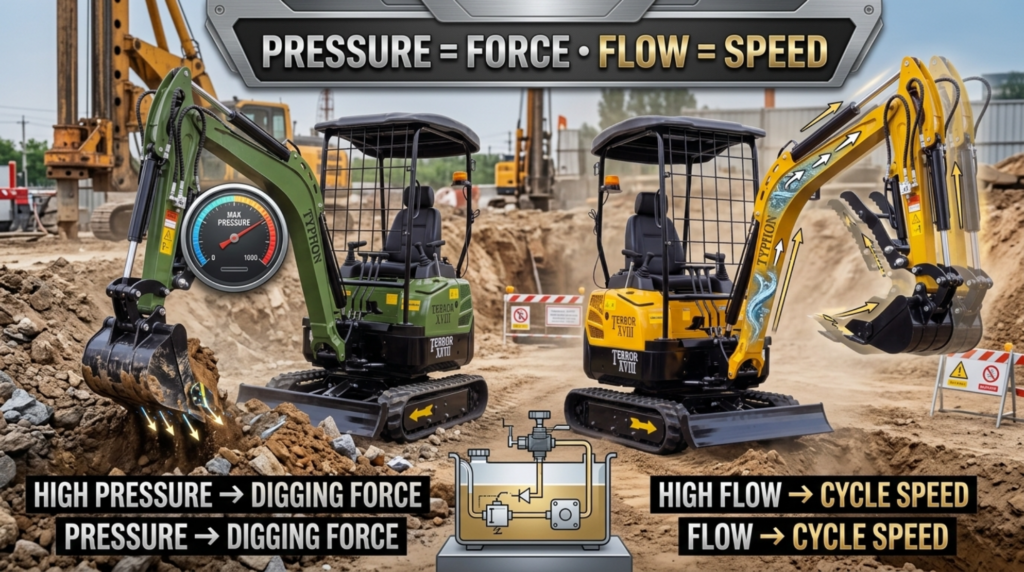
Flow shapes the everyday feel of the machine. Higher flow sends more fluid to the cylinders, which means faster cycle times and more work completed in a shift. An excavator with strong flow completes each dig-swing-dump cycle more quickly, and over hundreds of cycles a day that speed adds up to meaningful productivity. A machine with adequate pressure but limited flow may apply plenty of force yet feel sluggish, moving through its motions more slowly than the operator would like.
The key is that pressure and flow must work together to deliver useful performance. Consider how they combine:
- Pressure determines the force available to dig, lift, and hold against resistance.
- Flow determines how quickly the cylinders and motors carry out each movement.
- Balance between the two produces a machine that is both strong and responsive.
Neither figure means much in isolation. A machine with high pressure and low flow digs hard but works slowly, while high flow with low pressure moves quickly but lacks the force for tough material. The best-performing excavators pair the two thoughtfully, so the machine has both the strength to handle demanding work and the speed to complete it efficiently. When you compare machines, always read pressure and flow together rather than trusting either number alone.
Engine Power Supports the System
Behind every hydraulic function sits the engine, and it plays a decisive role in whether an excavator can sustain its performance under load. The engine drives the hydraulic pump, which pressurizes the fluid that powers the boom, arm, bucket, swing, and travel functions. Without enough engine output, the hydraulic system simply can’t maintain the pressure and flow its rating promises when the workload climbs. A pressure figure describes what the system can reach, but the engine determines whether the machine can hold that performance during real, demanding work.
The difference becomes clear under heavy load. Digging into compacted ground, running a high-demand attachment, or combining several functions at once all draw heavily on engine power. An excavator with an underpowered engine may hit its pressure rating in ideal conditions but struggle to sustain it when the going gets tough, causing the machine to slow down or bog. An engine sized to support the hydraulic system comfortably keeps the pump supplied with steady power, so the machine maintains its output instead of losing momentum when the operator needs it most.
This is why engine capability deserves attention alongside hydraulic specs. An engine matched to the hydraulic system handles peak demands without straining, which keeps performance consistent through long shifts and protects the machine over time, since an engine constantly pushed to its limit wears faster and runs less efficiently. When you evaluate an excavator, consider how much power the engine can actually deliver to the hydraulics under sustained load, not just the pressure the system is rated to reach. A well-matched engine is what turns a pressure figure on a spec sheet into dependable, sustained performance in the field, hour after hour.
Hydraulic Pressure and Digging Force
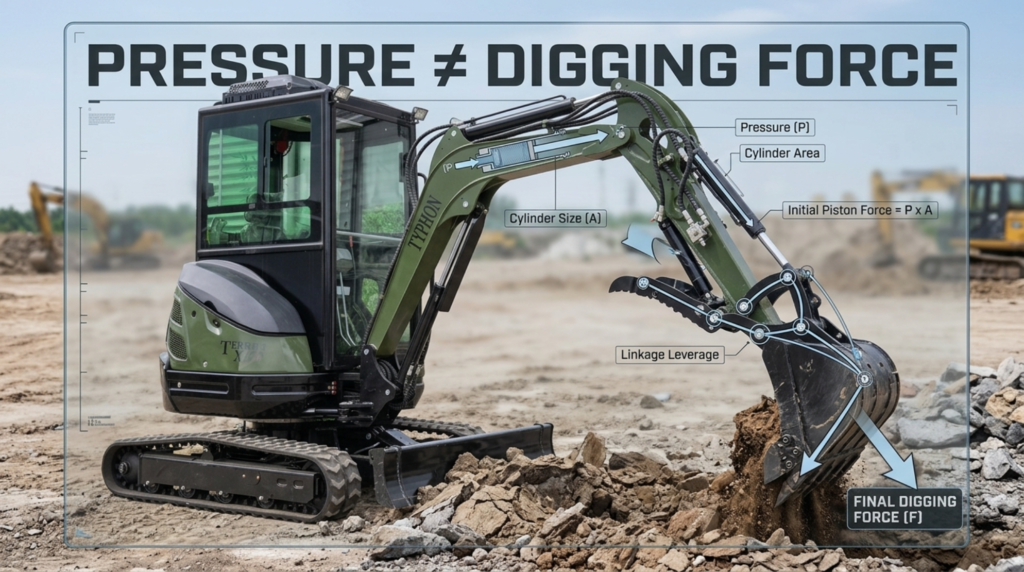
Digging force is often what buyers really care about, and it’s tempting to assume that a higher pressure rating automatically means a machine that digs harder. In truth, digging force is the product of several design factors working together, and pressure is only one of them. Bucket breakout force and arm crowd force depend on hydraulic pressure, cylinder size, linkage geometry, and the overall structure of the machine. Because so many elements contribute, pressure alone cannot tell you an excavator’s actual digging capability.
Cylinder size matters because force equals pressure applied across the piston area. A larger cylinder produces more force at the same pressure, which means a machine with modest pressure but generously sized cylinders can out-dig one with a higher rating and smaller cylinders. Linkage geometry adds another layer. The arrangement of the boom, arm, and bucket linkage determines the mechanical advantage at which that force is applied, and a well-designed linkage delivers strong, usable digging force across the working range rather than only at one position.
Several factors combine to produce real digging capability:
- Hydraulic pressure provides the underlying force the system generates.
- Cylinder size multiplies that pressure into the force applied at the bucket and arm.
- Linkage geometry governs the mechanical advantage and how force is delivered through the dig.
Manufacturers typically publish bucket breakout force and arm crowd force as the figures that actually describe digging capability, and these are the numbers to compare when digging performance matters most. They already account for the combined effect of pressure, cylinder size, and geometry. Reading pressure in isolation can mislead you, because a high figure paired with small cylinders or a weak linkage won’t dig as hard as the number suggests. For a true picture of digging strength, look at the breakout and crowd force ratings rather than pressure alone.
Matching Pressure to the Machine
The right hydraulic pressure for an excavator isn’t simply the highest available; it’s the pressure that fits the rest of the machine. Pressure has to be matched to the excavator’s size, pump, cylinders, and the attachments it will run. A higher pressure rating offers no real advantage if the pump can’t supply adequate flow at that pressure, the cylinders aren’t sized to use it, or the attachments don’t require it. The whole hydraulic system is engineered as a package, and pressure is meaningful only in the context of that package.
Matching pressure to the machine prevents two kinds of mismatch. A system rated for high pressure but paired with undersized components or limited flow can’t deliver on its number, leaving buyers paying for a figure the machine never fully uses. On the other end, an excavator asked to run demanding attachments without the pressure and flow to support them will underperform, running its tools slowly and straining the system. The goal is alignment, where pressure, pump, cylinders, and attachments all work within the same well-designed envelope.
This is why a spec sheet should be read as a whole rather than judged by a single headline figure. Attachment compatibility is a good example. High-flow tools like hydraulic breakers, augers, and compactors have their own pressure and flow requirements, and the excavator’s system must align with them to run them effectively. A machine whose pressure and flow match its intended attachments delivers reliable performance, while a mismatch leaves capability on the table. When you compare excavators, look for a hydraulic system whose pressure fits its size, components, and intended work, because a coordinated design consistently outperforms a machine chosen for an impressive pressure number alone.
Conclusion
Hydraulic pressure is a genuinely useful specification, but it’s only one piece of a much larger picture. Pressure determines the force an excavator can generate through its cylinders, yet that force only materializes when the system is designed to use it. Flow decides how fast the machine works, the engine determines whether performance holds up under load, and digging force depends on cylinder size and linkage geometry as much as on pressure itself. Above all, the right pressure is the one matched to the machine’s size, pump, cylinders, and attachments, not simply the highest number on the page. When you understand how pressure works together with these other factors, you can look past the headline figure and judge what an excavator can truly do. That fuller understanding is what helps you choose a machine that delivers dependable, efficient performance on the work you rely on it to handle.
Frequently Asked Questions
1. What does hydraulic pressure actually tell you about an excavator?
Hydraulic pressure indicates the force the hydraulic system can apply within its cylinders, which drives the boom, arm, and bucket. In that sense, it reflects the machine’s underlying muscle. However, pressure only translates into usable force when the cylinders, seals, valves, and structure are engineered to work at that rating. On its own, a pressure figure can’t tell you how fast the machine moves, how hard it digs, or whether it can sustain performance under load. It’s best understood as one part of a well-matched hydraulic system rather than a standalone measure of how capable the excavator is.
2. Is a higher hydraulic pressure rating always better?
Not necessarily. A higher pressure rating only helps if the rest of the hydraulic system is designed to use it. If the pump can’t supply enough flow at that pressure, the cylinders aren’t sized to apply it, or the attachments don’t require it, the extra pressure delivers no real benefit. Pressure must be matched to the excavator’s size, pump, cylinders, and intended attachments. A machine with a coordinated hydraulic design, where pressure, flow, and components all align, will consistently outperform one chosen for an impressive pressure number that the rest of the system can’t fully use.
3. What’s the difference between hydraulic pressure and hydraulic flow?
Pressure and flow measure two different things. Pressure describes how much force the system can apply, determining how hard the machine can push, lift, and dig. Flow, measured in gallons or liters per minute, describes how much fluid moves through the system over time, which determines how fast the functions operate. Pressure is the muscle; flow is the speed. Two excavators with the same pressure rating can perform very differently based on their flow rates. For useful performance, pressure and flow must work together, giving the machine both the strength for tough work and the speed to complete it efficiently.
4. Why does engine power matter for hydraulic performance?
The engine drives the hydraulic pump that pressurizes the system, so it’s the source of all hydraulic power. A pressure rating shows what the system can reach in ideal conditions, but the engine determines whether the machine can sustain that output under demanding work. Heavy digging, high-flow attachments, and combined functions all draw heavily on engine power. An underpowered engine may hit its rating on paper but bog down under real load, while an engine matched to the hydraulic system holds performance steady through long shifts. That’s why engine capability deserves attention alongside the hydraulic specifications themselves.
5. How can I judge an excavator’s digging capability if not by pressure?
Look at the published bucket breakout force and arm crowd force ratings, which describe digging capability directly. These figures already account for the combined effect of hydraulic pressure, cylinder size, and linkage geometry, so they give a truer picture than pressure alone. A machine with modest pressure but larger cylinders and a well-designed linkage can out-dig one with a higher pressure rating and smaller components. Because digging force depends on several design factors working together, comparing breakout and crowd force ratings is the most reliable way to assess how hard an excavator can actually dig.