 Trending
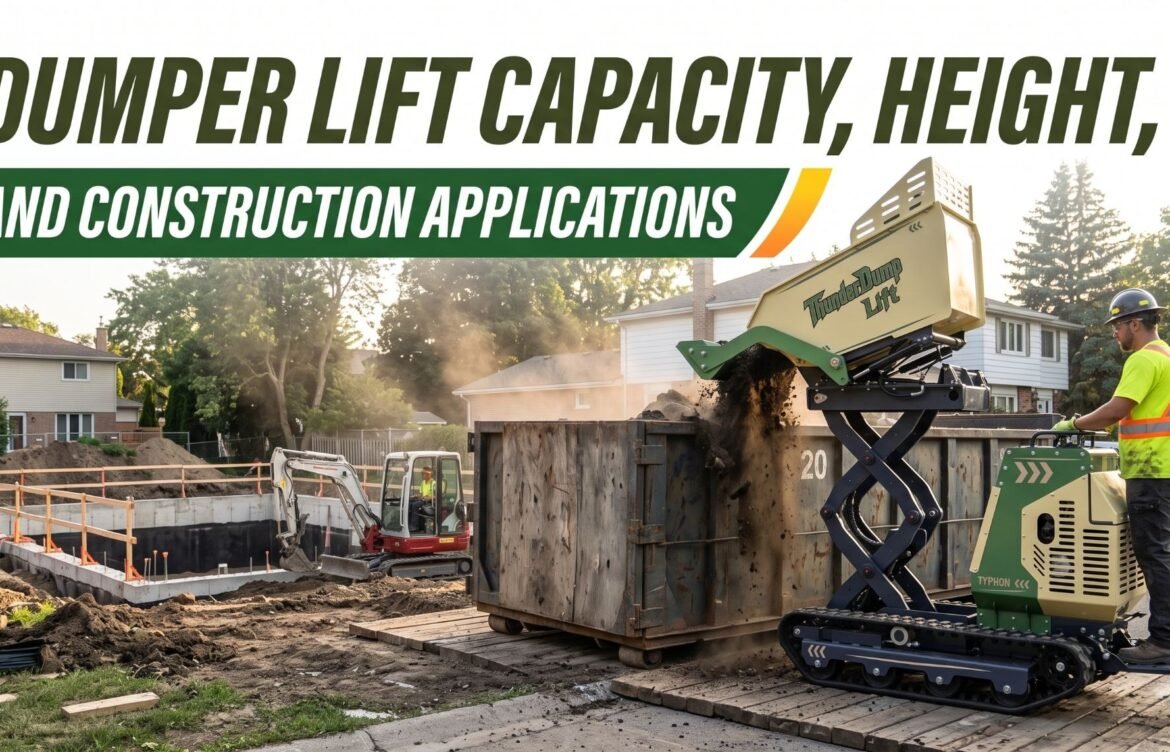
Hydraulic Lift Capacity and Dump Height for Construction Dumpers
Dumper performance depends on more than the amount of material a machine can carry. Jobs that require elevated discharge, such as loading roll-off containers or placing material over barriers, add lifting demands that can change stability and usable capacity. Load weight, distribution, tipping height, and ground conditions all need to be considered before moving material.
Lift capacity refers to the load the dumper can safely raise, while payload describes the material the machine can carry during travel. A heavy or poorly centered load can increase rear lift, slow the lifting system, or affect stability, especially when the skip is raised. High-tip and other dumper configurations provide different discharge options, but their rated capacities and operating limits must be followed.
Operators should check the rated travel and lifting capacities, assess material weight and moisture, and keep loads centered and appropriate for the intended tipping height. A firm, level tipping area also helps maintain stability while the skip is raised and discharged. Regular inspection of lift cylinders, hydraulic lines, pivot points, and related components helps keep the lifting system responsive and reliable during construction work.
Understanding Dumper Lift Capacity
Lift capacity describes how much load a dumper’s lifting system can raise safely under specified operating conditions. It’s a measure of what the skip, cylinders, pivots, and machine balance can handle while the load is being raised and tipped. Payload rating is a different figure. Payload describes how much weight the machine can safely carry during travel. The two numbers are related, but they don’t always match, and treating them as the same thing can put the machine and operator at risk.
The difference matters most on dumpers that raise the skip high. On a standard front-tip dumper, the skip tilts forward from a low pivot, and the load stays fairly close to the ground. On a high-tip dumper, the skip lifts upward before it tips, which moves the load’s weight higher and sometimes farther forward. That shift changes the machine’s balance. Depending on the model, the manufacturer may specify a lower load for high tipping than for travel, or set conditions such as level ground and a specific machine position. Swivel-skip dumpers add another factor, since tipping to the side changes how weight is distributed across the machine.
You’ll find capacity information on the machine’s decal and in the operator’s manual. Review every figure the manufacturer provides, including payload, skip volume, and any limits for high tipping or side tipping. Skip volume describes the space available, often listed as struck and heaped capacity. It doesn’t tell you how much weight the skip can safely hold or lift.
Exceeding lift capacity places heavy demands on hydraulic cylinders, seals, hoses, pivot pins, and mounting brackets. It also reduces the machine’s stability margin at the moment the load is highest. Signs of an overloaded lift include slow or hesitant skip movement, a light feeling at the rear of the machine, and uneven tipping. When you notice any of these, lower the skip and reduce the load before trying again.
Key takeaway: Lift capacity describes how much load the lifting system can safely raise under specified conditions, so distinguish it from payload and skip volume and follow every capacity limit the manufacturer provides.
Lift Height and Discharge Position
Lift height determines where a dumper can discharge material and whether it can load directly into containers, truck beds, or over raised edges. The right discharge height can reduce extra handling and make material placement more efficient, but the machine must also have enough reach, clearance, and stable positioning for the task.
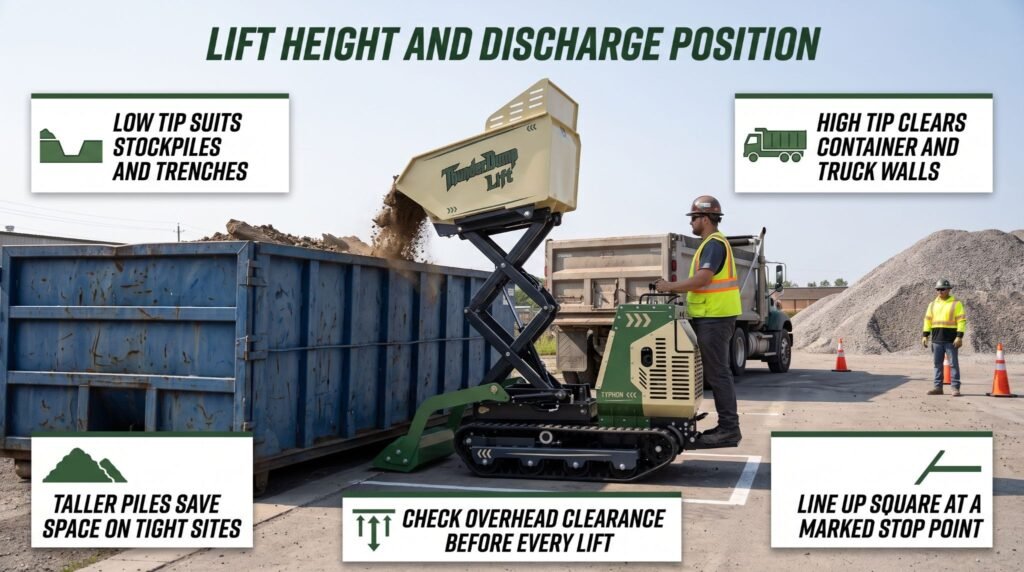
- Ground-Level Discharge: Front-tip dumpers are well suited for stockpiles, trenches, routes, and ground-level material placement.
- High-Side Loading: High-tip dumpers can discharge over container or truck walls, reducing the need for additional material-handling equipment.
- Stockpile Placement: Greater lift height allows material to be placed over raised edges and can help build taller stockpiles where site conditions allow.
- Discharge Reach: Lift height and forward reach work together to ensure the skip clears the receiving area and places material accurately.
- Overhead Clearance: Check for power lines, branches, scaffolding, and other overhead obstacles before raising the skip.
Key takeaway: Lift height determines where material can be discharged, so match discharge height and reach to the containers, trucks, and stockpiles on your site, and always confirm overhead clearance before raising the skip.
Construction Site Applications
Dumpers transport and discharge soil, sand, gravel, rock, demolition material, and many other construction loads. The right combination of capacity and lift height depends on the type of material, the distance traveled, and where the material needs to go. Matching the machine to the application keeps cycles efficient and reduces extra handling.
Excavation support is one of the most common applications. On foundation, basement, and utility projects, a dumper receives spoil directly from the excavator and carries it away from the dig. Where spoil goes to an on-site stockpile, a front-tip dumper with suitable payload often works well. Where spoils must go into containers or trucks, a high-tip machine can load directly and remove the need for a second machine to rehandle the material.
Material delivery is another key use. Gravel, sand, crushed stone, and base material often arrive at a single delivery point and must reach slabs, paths, trenches, and pads across the site. Front-tip and swivel-skip dumpers place material at ground level, and swivel skips can discharge to the side, which helps when filling trenches or placing material along a narrow route where turning space is limited.
Demolition and site cleanup bring different demands. Broken concrete, block, and mixed debris are heavy and irregular, so payload and load distribution deserve close attention. High-tip dumpers can load debris directly into roll-off containers, keeping the site clear and reducing manual handling.
Landscaping and restricted-access work often call for compact dumpers that fit through gates and narrow passages. In these settings, the machine’s width and ground pressure may matter as much as capacity. Tracked dumpers spread weight over soft ground, while wheeled dumpers generally travel efficiently on firm surfaces.
Travel distance shapes every application. Longer routes increase the value of a larger payload, since each trip carries more material. Shorter routes with frequent discharge may favor a smaller, more maneuverable machine. Review your typical jobs and choose the configuration that suits the work you do most often.
Key takeaway: Required capacity and lift height depend on the material, travel distance, and discharge location, so match the dumper configuration to excavation, delivery, demolition, or restricted-access work.
Ground Conditions and Machine Stability
Raising a loaded skip changes the machine’s center of gravity. As the skip lifts and tips, the load’s weight moves upward and forward, and on swivel skips, to the side. That shift makes the ground beneath the machine a critical part of every dumping cycle. Level, firm ground provides a stable base. Soft, sloped, or uneven ground can let the machine tilt just as it reaches its least stable position.
Always tip on firm, level ground. Soft soil, fresh fill, and saturated areas can compress under a loaded track or wheel, which tilts the machine as the load shifts. Ruts and holes can produce the same effect. Where the discharge point sits on questionable ground, lay timber mats or ground protection mats to create a firm tipping pad, or move the discharge point to better ground.
Slopes deserve particular caution. Never tip across a slope, since the raised load moves the center of gravity toward the downhill side. Follow the manufacturer’s limits for dumping on grades and for machine position during high tipping. High-tip and swivel-skip operations are generally more sensitive to ground angle than low front-tip discharge, so check the operator’s manual for any specific restrictions.
Excavation edges and embankments create a separate hazard. Ground near a fresh cut can collapse under the weight of a loaded dumper, especially as the load shifts forward during tipping. Keep the machine well back from edges, and use secured stop blocks or wheel stops placed at a safe distance where the work requires dumping into or near an excavation. Never rely on judgment alone to stop at an edge.
Prepare and maintain the tipping area throughout the job. Repeated cycles can wear ruts into a dump point, and rain can soften ground that was firm earlier in the day. Recheck the area regularly, refresh mats as needed, and lower the skip fully before traveling away from the discharge point.
Key takeaway: Raising a loaded skip shifts the machine’s center of gravity, so tip only on firm, level ground, avoid side slopes, keep back from edges, and prepare a stable tipping pad where needed.
Material Weight and Load Distribution
Different materials have very different densities, so the same skip volume can produce very different load weights. A skip filled with dry topsoil may sit comfortably within the machine’s limits, while the same skip filled with wet clay, crushed stone, or broken concrete can exceed them. Dense materials often reach the weight limit long before the skip looks full.
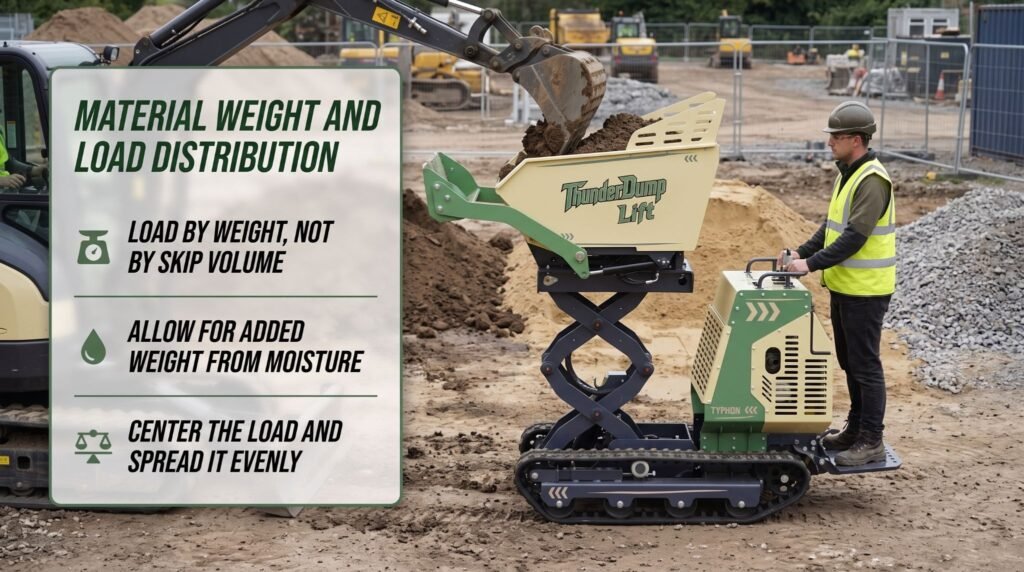
Moisture has a major effect on weight. Soil that was dry in the morning can become noticeably heavier after rain, and saturated clay adds weight quickly. Sand also gains significant weight when damp. Estimate each load using the material’s approximate density and current moisture, and load by weight rather than by how full the skip appears. When you’re unsure, start with a smaller load and observe how the machine lifts and travels.
Distribution inside the skip matters as much as total weight. A load concentrated heavily on one side places uneven force on the lift cylinders and pivot points, and it can shift the machine’s balance during tipping. A load heaped toward the front moves weight forward, which becomes more significant as the skip rises. The aim is a load centered across the skip and spread evenly from front to back.
Good loading practice starts with coordination. Ask the excavator or loader operator to place material gently in the center of the skip rather than dropping full buckets from height or onto one side. Avoid heaping loose material so high that it spills during travel. Clear sticky material such as wet clay from the skip regularly, since buildup adds weight and can cause part of the load to hang up and release suddenly during tipping.
Watch how the machine responds to each load. A skip that lifts slowly, hesitates partway, or tips unevenly is often carrying too much weight or an unbalanced load. Lower the skip, redistribute or remove material, and adjust the next load before continuing.
Key takeaway: Material density and moisture determine actual load weight, so load by weight, keep material centered and evenly distributed, and adjust loads whenever the lift feels slow or unbalanced.
Lift System Maintenance
The lift system carries the heaviest loads on a dumper and works through repeated cycles every day. Hydraulic cylinders, hoses, pivot points, pins, hinges, and mounting components all need regular attention. Consistent maintenance keeps the skip moving smoothly and reduces the risk of leaks, excessive wear, and unexpected movement.
Begin every inspection with the machine parked on firm, level ground, the skip fully lowered, the engine off, and the key removed. If you must inspect with the skip raised, engage the manufacturer’s skip prop or safety support first. Never place any part of your body beneath a raised skip held only by hydraulic pressure.
Inspect each lift cylinder closely. Check rods for scoring, nicks, rust, and bends, and look for fresh oil or a dust-caked ring around the seals. On high-tip machines, inspect every cylinder in the lifting and tipping linkage, since these designs often use more than one. Check hoses and fittings for cracks, abrasion, bulges, and spots where hoses rub against the frame or skip. Never check for leaks by running your hand along a hose. Pressurized fluid can penetrate skin and cause serious injury, so use a piece of cardboard instead. Relieve system pressure according to the manufacturer’s procedure before loosening any fitting.
Pivot points, pins, and hinges carry concentrated loads with every lift. Confirm each pin is fully seated and that retaining bolts, clips, or cotter pins are present. Look for elongated pin bores, fresh metal shavings, and cracks in mounting brackets and nearby welds. Grease every pivot according to the manufacturer’s schedule, and more often in muddy or heavy-duty conditions. Wipe fittings clean before greasing, and replace any fitting that won’t accept grease.
Machine behavior reveals a lot about lift system health. A skip that lifts slowly, moves unevenly, hesitates, or drifts down with the control in neutral needs attention before it returns to work. Keep hydraulic fluid at the correct level and in clean condition, follow the manufacturer’s service intervals for fluid and filter changes, and record every inspection and repair in a maintenance log.
Key takeaway: Regularly inspect cylinders, hoses, pivot points, pins, hinges, and mounting components, and repair leaks, wear, or unusual movement before continued operation to keep the lift system safe and dependable.
Conclusion
Dumper lift capacity and lift height directly determine how effectively a machine handles material on a construction site, and the best results come from matching both to the actual work rather than relying on any single specification. Understanding the difference between lift capacity, payload, and skip volume keeps every lift within safe limits, while choosing the right lift height lets material go straight into containers, trucks, and stockpiles without extra handling. Loading by weight and keeping material centered protects the lift system and the machine’s balance, and selecting the right configuration for excavation, delivery, demolition, or restricted-access work keeps cycles efficient. Firm, level tipping ground supports stability as the raised load shifts the center of gravity, and consistent inspection and lubrication keep cylinders, pivots, and pins ready for demanding daily use. Before your next project, review the manufacturer’s capacity and lift height figures, compare them with your containers, trucks, and typical materials, and prepare a firm, level tipping area so your dumper delivers safe, efficient material dumping from the first load to the last.
Frequently Asked Questions
What does dumper lift capacity mean?
Dumper lift capacity describes how much load the lifting system can raise safely under specified operating conditions. This capacity can differ from the machine’s rated travel payload, particularly on high-tip and swivel-skip dumpers. Operators should consider both limits and follow the manufacturer’s specifications when lifting and discharging material.
Why is lift height important?
Lift height determines how high the skip can rise and where the material can be discharged. Greater lift height can allow a dumper to load containers, hoppers, or trucks directly, reducing the need for additional handling equipment. The required height should match the discharge point while keeping the machine within its rated operating limits.
Does material density affect dumper operation?
Yes. Dense, wet, or heavy materials can reach the machine’s weight limits before the skip is completely full. Material should be loaded based on weight and distributed evenly across the skip rather than relying only on available volume. Staying within the rated payload helps maintain predictable handling and reduces unnecessary stress on the machine.
Why does ground condition matter during dumping?
Raising a loaded skip shifts the machine’s center of gravity upward and can move the load toward the discharge side. Firm, level, and suitable ground provides a more stable base and reduces the risk of tilting during dumping. Operators should avoid dumping on unstable or excessively sloped surfaces and follow the manufacturer’s dumping requirements.