 Trending
How Working Pump Pressure Affects Skid Steer Breakout Force
Breakout force is one of the truest measures of what a skid steer can accomplish. It is the force the machine applies at the bucket to pry material loose, whether that means lifting a heavy pile, curling through packed earth, or prying stubborn debris from the ground. At the heart of that force sits hydraulic pressure, the working pressure your pump delivers to the lift and bucket cylinders every time you dig. Understanding how that pressure translates into usable breakout force helps you judge a machine’s real capability, diagnose performance problems, and get dependable results from your equipment. This guide explains how working pump pressure shapes breakout force, along with the cylinder sizing, component ratings, and system efficiency that determine whether that force reaches the bucket.
How Hydraulic Pressure Generates Skid Steer Breakout Force
Hydraulic pressure is the foundation of breakout force, because it directly determines how much force the lift and bucket cylinders can produce. When you curl the bucket into a pile or drive it into compacted ground, the machine has to overcome real resistance. It meets that resistance through pressurized hydraulic oil pushing against the pistons inside the cylinders, and the force those cylinders generate is what pries the material loose. The higher the working pressure acting on the pistons, the more force the cylinders can apply at the bucket.
This is why working pressure is such a central specification. A skid steer capable of maintaining strong hydraulic pressure has more force available to break through resistant material, while one running lower pressure has less to work with when the ground fights back. Higher working pressure can increase the breakout force available at the bucket, giving the machine the muscle demanding digging required.
That increase comes with an important condition, however. The extra force is only usable when the hydraulic cylinders and the components feeding them are designed to handle the pressure involved. Cylinders, seals, hoses, and valves are all rated to operate safely within a defined pressure range, and the system is built to work inside those limits. Pressure that stays within what the components can manage produces reliable, sustained breakout force, while pushing beyond those ratings risks damage rather than delivering useful extra power. When the working pressure is matched to a system engineered to handle it, the result is a dependable breakout force the operator can count on with every pass.
How Cylinder Size Affects Breakout Force
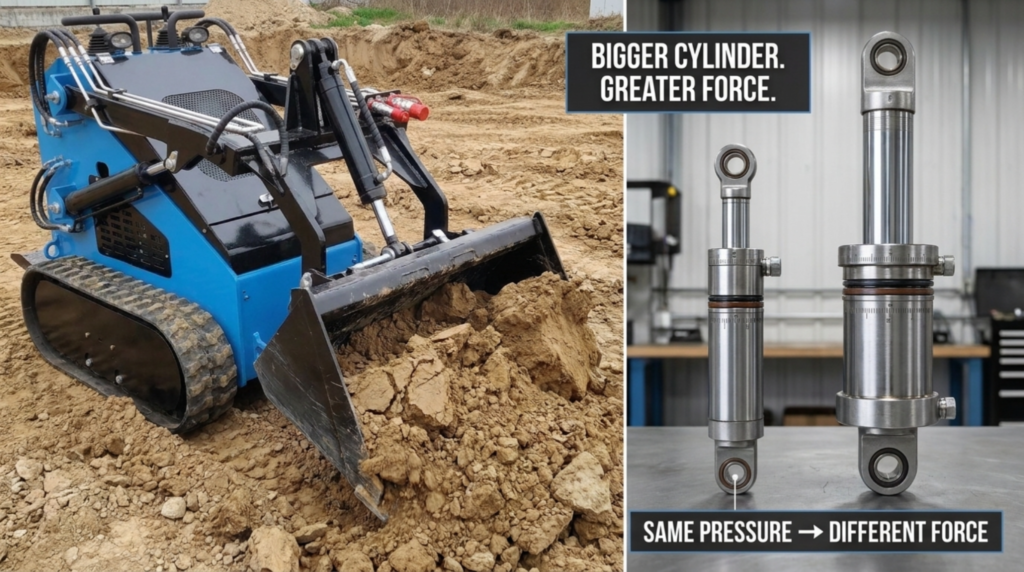
Hydraulic pressure never works alone in producing force. It works together with the cylinder area, and understanding this relationship is essential to understanding breakout performance. The force a cylinder generates depends on both the pressure of the oil and the surface area of the piston that oil pushes against. Pressure supplies the push per unit of area, while the piston area determines how much surface that push acts upon. Multiply the two together, and you get the force the cylinder delivers.
This is why cylinder size carries so much weight in breakout performance. A larger cylinder has a greater piston area, so at the same hydraulic pressure it produces more force than a smaller one. Picture the same pressure acting on a wider piston: because it presses against more surface, the total force climbs. In practical terms, a machine with generously sized lift and bucket cylinders can generate substantial breakout force even at a given working pressure, simply because that pressure is acting across a larger area.
The takeaway for judging a skid steer is that pressure and cylinder sizing must be considered together, not in isolation. A high working pressure paired with modestly sized cylinders may produce less breakout force than a moderate pressure acting on larger cylinders. Manufacturers balance these two factors deliberately, matching cylinder dimensions to the system’s working pressure to deliver the intended breakout capability. When you evaluate a machine’s digging power, look beyond the pressure figure alone and consider how the cylinders are sized to use it. That combination is what ultimately decides how much force reaches the bucket, and it is why cylinder sizing is a genuine part of breakout performance rather than an afterthought.
How Low Working Pressure Can Reduce Digging Performance
Everything about breakout force depends on the hydraulic system actually delivering its intended working pressure. When it cannot, digging performance suffers directly. If the system fails to maintain the pressure it was designed to produce, the cylinders cannot generate their designed force, and the machine loses the muscle it needs at exactly the moment demanding work calls for it. The bucket that should curl confidently through packed soil instead stalls against the resistance.
The consequences show up most clearly in the toughest material. Breaking through compacted soil or penetrating dense material requires the cylinders to apply strong, sustained force, and that force is only available when the working pressure is where it should be. When pressure falls short, the machine may struggle to bite into hard-packed ground, hesitate as it meets resistance, or fail to pry loose material it should handle with ease. Work that ought to move quickly instead becomes slow and frustrating, and the operator feels the machine straining without result.
Low working pressure can stem from several sources, from a pump no longer performing to specification to internal leakage or restrictions bleeding pressure from the circuit. Whatever the cause, the effect is the same: reduced force at the bucket and diminished digging capability. This is why maintaining proper working pressure matters so much to real-world performance. A skid steer kept in sound hydraulic condition holds the pressure its cylinders need to produce full breakout force, penetrating dense material and breaking through compaction the way the machine was built to. Protecting working pressure means protecting the digging performance you depend on, ensuring the machine delivers its designed force pass after pass rather than falling short when the ground gets hard.
Why Higher Pressure Does Not Always Mean More Breakout Force
It might seem that simply raising hydraulic pressure would always yield more breakout force, but the reality is more nuanced. Increasing pressure does not automatically make a skid steer perform better, because the machine is a system of interdependent parts, each with its own limits. Pressure can only translate into usable force when every component in the chain and the machine itself can support it.
The first limit is the components themselves. The pump, cylinders, valves, hoses, and fittings must all be rated for the pressure the system runs. Pushing pressure beyond what these parts are designed to handle does not deliver reliable extra force; it invites leaks, seal failures, and component damage that undermine performance rather than improve it. A hydraulic system is engineered as a matched set, and its safe, usable pressure is bounded by the ratings of every part within it.
The second limit lies in the machine’s physical relationship with the ground. Even if the cylinders could apply enormous force, the skid steer’s traction and operating weight cap how much of that force is actually usable. Breakout force works against the material, and the machine needs enough grip and mass to stay planted while the bucket pries. If the cylinders apply more force than the machine’s weight and traction can anchor, the skid steer simply loses grip or lifts itself rather than breaking the material loose. This is why breakout capability reflects a balance across the whole machine. Pressure, component ratings, cylinder sizing, traction, and weight all work together, and genuine breakout performance comes from matching these elements rather than chasing pressure alone.
How Hydraulic System Efficiency Affects Breakout Performance
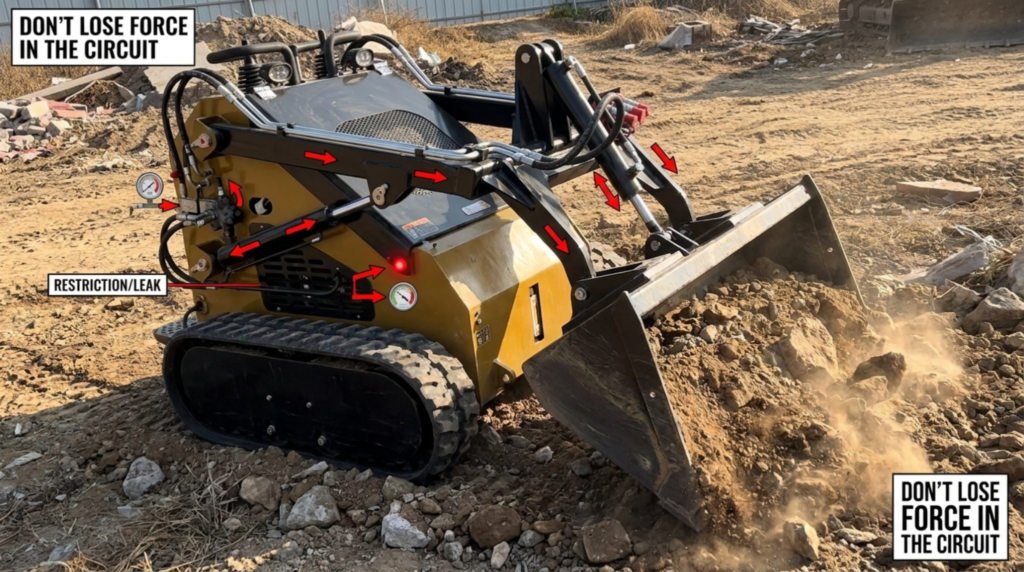
Producing pressure at the pump is only half the story. That pressure must reach the cylinders efficiently to convert engine power into useful digging force at the bucket. A hydraulic system is the pathway between the engine and the work, and how well that pathway carries pressure determines how much of the machine’s potential actually arrives where it matters. When the system moves pressure cleanly to the cylinders, engine power becomes a breakout force. When it does not, force is lost along the way.
Internal leakage is one of the primary drains on that force. Inside pumps and valves, oil can slip past close-fitting clearances rather than doing useful work, and every bit that leaks internally is pressure that never reaches the cylinders. Pressure losses through the circuit compound the problem. Restrictive hoses, worn valves, or poor system condition force the oil to expend energy simply moving through the machine, leaving less pressure available at the bucket. The pump may be operating and generating pressure, yet the force delivered to the cylinders falls short of what the machine should produce.
This is why hydraulic system condition matters so much to breakout performance. A system in good order, with sound components and clean oil, carries pressure to the cylinders with minimal loss, so the machine converts its engine power into full digging force. A system suffering from leakage, restriction, or general wear bleeds away force that should be prying material loose, leaving the operator with a machine that underperforms even when the pump is running. Maintaining hydraulic efficiency through sound components, proper oil condition, and attention to leaks and restrictions protects the force at the bucket. It ensures the working pressure your pump produces actually becomes the breakout force your work demands, pass after pass.
Conclusion
Working pump pressure sits at the center of a skid steer’s breakout force, but it never acts alone. Pressure determines how much force the lift and bucket cylinders can produce, and higher working pressure can increase available breakout force when the components are built to handle it. That pressure works together with cylinder area, so cylinder sizing plays an equally important role in the force delivered at the bucket. When the system cannot maintain its intended pressure, the cylinders fall short of their designed force, making dense, compacted material far harder to break. Yet simply raising pressure is no guarantee of better performance, because component ratings, traction, and operating weight all cap the force a machine can usefully apply. Finally, that pressure must reach the cylinders efficiently, since internal leakage and pressure losses can rob the bucket of force even while the pump runs. Judge a skid steer by how well all these elements work together, and you will understand the true source of its digging power. Keep the hydraulic system in sound condition, and it will deliver the dependable breakout force your work demands.
Frequently Asked Questions
1. How does hydraulic pressure generate breakout force in a skid steer?
Hydraulic pressure directly determines how much force the lift and bucket cylinders can produce. When you curl the bucket into a pile or drive it into compacted ground, the machine overcomes that resistance through pressurized oil pushing against the pistons inside the cylinders. The force those cylinders generate is what pries the material loose, so the higher the working pressure acting on the pistons, the more force available at the bucket. This makes working pressure a central specification for digging capability. A machine that maintains strong pressure has more force to break through resistant material, while one running lower pressure has less to work with. Importantly, that force is only usable when the cylinders, seals, hoses, and valves are designed to handle the pressure involved. When working pressure is matched to a system engineered to manage it, the machine delivers dependable breakout force on every pass.
2. Why does cylinder size matter as much as pressure?
Cylinder size matters because hydraulic pressure works together with cylinder area to determine the force produced. The force a cylinder generates depends on both the pressure of the oil and the surface area of the piston that oil pushes against. Pressure supplies the push per unit of area, while the piston area determines how much surface that push acts upon, and multiplying the two gives the total force. As a result, a larger cylinder with a greater piston area produces more force than a smaller one at the same hydraulic pressure. This means a high working pressure paired with modestly sized cylinders may produce less breakout force than a moderate pressure acting on larger cylinders. Manufacturers balance the two deliberately, matching cylinder dimensions to working pressure. When judging a machine’s digging power, always consider how the cylinders are sized to use the pressure available.
3. What happens if a skid steer cannot maintain its working pressure?
If the hydraulic system cannot maintain its intended working pressure, the cylinders cannot produce their designed force, and digging performance suffers directly. The effect shows up most clearly in tough material. Breaking through compacted soil or penetrating dense material requires strong, sustained cylinder force, and that force is only available when working pressure is where it should be. When pressure falls short, the machine may struggle to bite into hard-packed ground, hesitate against resistance, or fail to pry loose material it should handle easily. Work that ought to move quickly becomes slow and frustrating, with the machine straining without result. Low pressure can stem from a pump no longer performing to specification, internal leakage, or restrictions bleeding pressure from the circuit. Whatever the cause, the effect is reduced force at the bucket, which is why maintaining proper working pressure is essential to real-world digging capability.
4. Does increasing hydraulic pressure always improve breakout force?
No. Simply increasing hydraulic pressure does not automatically make a skid steer perform better, because the machine is a system of interdependent parts with real limits. The first limit is the components: the pump, cylinders, valves, hoses, and fittings must all be rated for the pressure the system runs. Pushing beyond those ratings invites leaks, seal failures, and component damage rather than reliable extra force. The second limit is the machine’s relationship with the ground. Even if the cylinders could apply enormous force, the skid steer’s traction and operating weight cap how much of that force is usable. Breakout force works against the material, so the machine needs enough grip and mass to stay planted while the bucket pries. If the cylinders apply more force than the machine can anchor, it loses grip or lifts itself rather than breaking material loose. Genuine breakout performance comes from balancing all these elements.
5. How does hydraulic system efficiency affect breakout performance?
Producing pressure at the pump is only useful if that pressure reaches the cylinders efficiently, since that is how engine power converts into digging force at the bucket. Internal leakage is a primary drain on this force. Inside pumps and valves, oil can slip past close-fitting clearances rather than doing useful work, and every bit that leaks internally is pressure that never reaches the cylinders. Pressure losses through restrictive hoses, worn valves, or poor system condition compound the problem, forcing oil to expend energy simply moving through the machine and leaving less pressure at the bucket. The pump may be running and generating pressure, yet the force delivered falls short of what the machine should produce. A system in good order carries pressure to the cylinders with minimal loss, while one suffering leakage or wear bleeds away force. Maintaining hydraulic efficiency protects the breakout force your work demands.